

Mole Control
Molehills, raised turf, uprooted flower beds: we find the active tunnels and deal with the problem at the source.
Do you have moles? The telltale signs
- Molehills: small mounds of loose soil on the lawn
- Ridges of raised turf winding across the yard that sink underfoot
- Flower beds and seedlings pushed up, with their roots exposed
- Tunnels that are raised again a few days after you flatten them
- More activity in spring and fall
One or two moles are often enough to damage a whole yard (Health Canada).
Getting to know the mole
Two mole species dig in Quebec yards: the hairy-tailed mole and the star-nosed mole. Knowing how they live explains why home remedies so often fail.
Description
Reproduction
Habits
Diet
Risks and damage
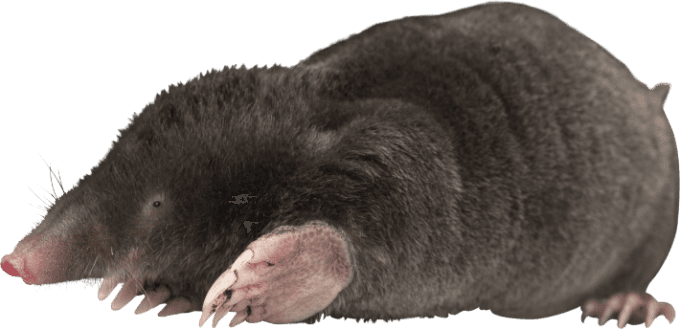
The hairy-tailed mole is 13 to 17 cm long and weighs 40 to 65 g. It has a pointed snout, dark grey, almost black fur and a short, hairy tail (Quebec government fact sheet, in French). The star-nosed mole has a nose ringed with 22 star-shaped feelers and a long, almost hairless tail; it lives mostly near water, in wet soil (CEAEQ, in French). Both have broad, shovel-like front feet, tiny eyes and no visible ears.
Moles have one litter a year. In the hairy-tailed mole, mating runs from late March to early May. After four to six weeks of gestation, the female gives birth to 4 or 5 young on average, in May or June. They are weaned at about 30 days (CEAEQ, in French).
Moles don’t hibernate: they are active all year, day and night. In winter they move down below the frost line (Quebec government fact sheet, in French). Each lives alone in a network of tunnels: surface runs a few centimetres under the turf, where it hunts, and deep runs more than 25 cm down, where the soil in molehills comes from. It digs about 10 m of surface tunnel an hour.
Contrary to popular belief, moles eat almost no plants. They feed on earthworms, grubs and insects; earthworms make up about a third of the hairy-tailed mole’s diet (CEAEQ, in French). Roots die because the tunnels lift them out of the soil. Voles use the tunnels and eat the exposed roots (Health Canada).
No diseases are known to pass from moles to people (ICWDM). The problem is damage: a torn-up lawn, uprooted beds, a yard full of tunnels you can trip on, and patio stones that can shift.
How we deal with moles
Inspection first. We find the active tunnels: we flatten a section and check a few days later whether it has been raised again (Health Canada). That is where the mole travels every day.
Trapping in active tunnels. It is the most effective method, according to both the Quebec government and university extension services (Quebec government fact sheet, in French). Quebec law allows a person to kill an animal that is damaging their property when it cannot otherwise be stopped (Act respecting the conservation and development of wildlife, s. 67).
Follow-up. Once a yard is cleared, other moles can move in over time (ICWDM). We come back to check and show you which areas to watch.
What you can do right now
- Flatten the tunnels with your foot and note which ones are raised again: those are the active runs
- Don’t rely on ultrasonic or vibrating devices: none has been proven to work (Penn State Extension)
- Avoid spraying the lawn with insecticide to “starve” the moles: it rarely works, and the Quebec government advises against it
- Don’t pour products into the tunnels: fumigants are largely ineffective against moles
- To protect a small, valuable flower bed, sink a sheet-metal or brick edging 30 cm into the ground
Our guarantee. Our treatments are guaranteed for a period agreed in advance: if the problem comes back, so do we, with no hidden fees.
Moles: frequently asked questions
Is it a mole or a vole?
A mole leaves molehills and raised ridges; it has shovel-like front feet, tiny eyes and no visible ears. A vole is a small rodent with clearly visible black eyes: it makes 2.5 to 5 cm runways through the grass and gnaws the bark at the base of trees (Health Canada).
Do castor oil repellents work?
Should I get rid of grubs to make moles leave?
Do moles hibernate?
How much does mole control cost?
Moles in your yard?
Call 514-638-8705 (toll-free: 1-855-472-3352), 24 hours a day, or fill in the form: the estimate is free.