
You spotted a large black ant in your home and are not sure which species you are dealing with. In Quebec, two species are frequently confused: the carpenter ant and the common black ant. Their appearance may seem similar, but their behaviours, risks and the interventions they require are very different. Here is how to tell them apart.
Carpenter Ant: The Silent Destroyer
Visual Identification
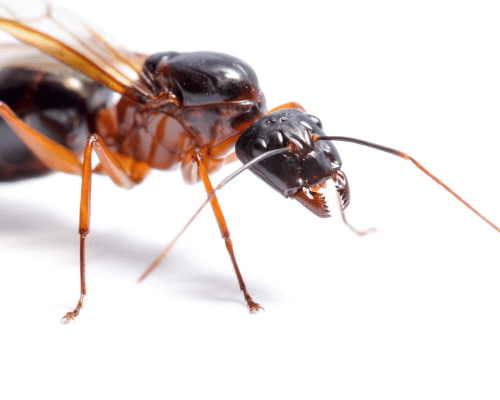
The carpenter ant (genus Camponotus) is among the largest ant species found in Quebec. Workers measure between 6 and 12 mm depending on their role in the colony, with queens being considerably larger. Their body is black, sometimes with dark brown or reddish highlights around the thorax. Their size and robust silhouette set them clearly apart from the common black ant.
Behaviour and Signs of Activity
Unlike termites, carpenter ants do not eat wood. Instead, they excavate it to build their galleries and establish their colonies. They prefer damp or already damaged wood: basement beams, poorly sealed window frames, spaces around pipes. Their presence leaves characteristic signs: fine wood shavings known as frass accumulate beneath infested areas, and faint crackling sounds may be heard inside walls. They are most active at night.
Risks to Your Home
A carpenter ant colony can contain several thousand individuals. Left untreated, it can expand over several years and seriously weaken the wooden structures of your home. Repair costs from a neglected infestation can be substantial. In winter, they slow their activity but remain present inside heated buildings, continuing to excavate in warm areas of the home.
Black Ant: A Food-Seeking Nuisance
Visual Identification
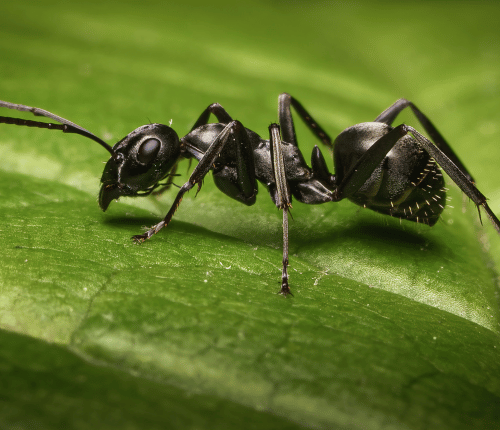
Common black ants (genus Lasius) are noticeably smaller than carpenter ants. They measure between 2 and 5 mm and their body is uniformly black, without any coloured highlights. Their small size is the first distinguishing criterion.
Behaviour and Signs of Activity
Black ants do not attack wood. Their main activity is foraging for food: sugars, crumbs, food scraps. They enter homes through cracks, door gaps or spaces around pipes, leaving chemical trails for other workers to follow. You will typically spot them in organized columns heading toward a food source, or in outdoor nests near foundations. They cause no structural damage, but their presence in a kitchen creates hygiene concerns.
How to Tell the Two Species Apart
Size
This is the most immediate criterion. A carpenter ant measures between 6 and 12 mm, which is two to four times the size of a common black ant (2 to 5 mm). If the ant you found seems large, that is often a first indicator pointing toward the carpenter ant.
Colour
Both species are black, which explains the frequent confusion. The difference lies in the nuances: carpenter ants often show dark brown or reddish highlights around the thorax, while common black ants are uniformly black across the entire body.
Behaviour
Carpenter ants attack wood and establish themselves inside the structure of your home. Black ants forage for food and nest primarily outdoors. If you see ants emerging from a crack in a wall or a beam, that is a strong signal pointing toward the carpenter ant.
Signs of Activity
Carpenter ants leave frass (fine wood shavings mixed with debris) near the areas they excavate. Black ants leave well-organized columns heading toward food sources and earthen nests outdoors, often at the base of walls or under patio slabs.
A note on large black ants: if you have found a large black ant inside your home, it is likely a carpenter ant. The common black ant stays small. A large black ant spotted near a wooden structure or in a damp basement warrants a prompt inspection.
Comparison Table
| Characteristic | Carpenter Ant | Black Ant |
|---|---|---|
| Size | 6 to 12 mm | 2 to 5 mm |
| Colour | Black with brown/reddish highlights | Uniformly black |
| Preferred habitat | Damp wood, interior structures | Outdoor soil, foundations |
| Behaviour | Excavates wood to nest | Forages for food |
| Risks | Structural damage | Hygiene concerns |
| Winter activity | Remains active indoors | Inactive outdoors |
Prevention and Infestation Management
Inspect Your Home Regularly
Look for signs of activity in high-risk areas: basements, bathrooms, kitchens and spaces around pipes. Frass near a beam or window frame is a warning sign that should not be ignored.
Reduce Moisture and Food Sources
Repair plumbing leaks and properly ventilate damp spaces. Store food in airtight containers and clean up crumbs after every meal. These habits significantly reduce your home’s appeal to both species.
Seal Entry Points
Caulk cracks around windows, doors and foundations. Check the condition of door seals and spaces around pipes. Carpenter ants can enter through very small openings, particularly where wood is in contact with soil or foundations.
Eliminate Outdoor Nests
For black ants, locate outdoor nests and treat them with Health Canada-approved baits. For carpenter ants, professional inspection is often required: their main nests are frequently located outdoors in a dead tree or stump, with satellite nests inside the home.
Call in a Professional
A carpenter ant infestation can quickly become difficult to manage without professional intervention. The Integral XT team offers thorough inspections and tailored treatments to eliminate these pests effectively while minimizing disruption to your home.
Conclusion
Telling a carpenter ant apart from a black ant is the first step toward choosing the right intervention. Size, colour and behaviour are the three criteria to assess first. If you are unsure, especially when facing a large black ant spotted near a wooden structure, a professional inspection remains the safest way to evaluate the situation. Contact Integral XT for a prompt and personalized assessment.
Frequently Asked Questions (FAQ)
How Do You Identify a Carpenter Ant?
The carpenter ant is first identified by its size: between 6 and 12 mm, it is noticeably larger than other common ant species in Quebec. Its body is black with occasional dark brown or reddish highlights around the thorax. It often moves alone or in small groups, unlike black ants which travel in well-organized columns. The presence of frass near wooden structures is also a strong indicator.
Are Carpenter Ants Active in Winter?
Yes, unlike black ants which become inactive outdoors in autumn, carpenter ants remain present inside heated buildings throughout winter. They slow their activity but continue excavating galleries in warm areas. An untreated infestation before winter can therefore worsen by spring.
Is a Large Black Ant Always a Carpenter Ant?
Not necessarily, but it often is in Quebec. The common black ant (Lasius) measures between 2 and 5 mm and stays small. If you find a black ant exceeding 6 mm, there is a strong likelihood it is a carpenter ant. Its presence indoors, near wood or in a damp basement, reinforces that hypothesis. For more information on carpenter ant identification and treatment options, visit our identification page.
What Is the Difference Between a Carpenter Ant and a Termite?
Both insects attack wood, but in very different ways. Termites eat wood from the inside, leaving the surface apparently intact. Carpenter ants excavate it and leave frass visible outside their galleries. Carpenter ants are black with a recognizable size, while termites are generally whitish and avoid light. Termites are rare in Quebec, though their presence is possible in some regions. For guidance on how to get rid of ants in your home, consult our complete guide.