
You’ve spotted a small rodent in your garden, basement or attic — and you’re not quite sure which species you’re dealing with. It’s not a minor detail: depending on whether it’s a vole, a mouse or a rat, the damage, health risks and solutions you’ll need are very different. Here’s a practical identification guide built around real situations encountered in Quebec.
The Vole: Characteristics, Habitat and Signs of Presence
What Does a Vole Look Like?
The vole is the species most likely to cause confusion, largely because it superficially resembles a mouse. But a few seconds of observation are enough to tell them apart.
Its body is stocky and measures between 9 and 12 cm. Its snout is rounded — not pointed like a mouse’s — and its small ears nearly disappear into its fur. The most reliable identifier is its tail: short, measuring roughly one third of its body length. Its coat is dark brown on the back with a greyish belly.
In Quebec, the most common species belong to the genus Microtus — notably the meadow vole and the red-backed vole. They are found mainly in grassy areas, gardens, cultivated fields and forest edges. They very rarely enter buildings.
A useful clarification: in everyday Quebec usage, the word field mouse is often used interchangeably with vole, although the two are technically distinct species. If you’re looking to tell them apart specifically in order to choose the right treatment, see our dedicated article on the subject.
How to Recognize the Presence of a Vole?
Voles are rarely seen directly — it’s what they leave behind that gives them away.
The most telling sign is the surface runway: a narrow, well-worn path through the grass, often accompanied by vegetation clipped at the base. In winter, these runways run beneath the snow and only become visible at snowmelt, appearing as channels in the lawn.
Other typical signs include gnawed roots or bulbs in garden beds, small round droppings (3 to 5 mm) inside runways, and stems cut cleanly a few centimetres above the ground.
Voles are active day and night, unlike mice and rats, which are essentially nocturnal. They can cause significant damage to gardens, lawns and vegetable patches — sometimes without ever being directly observed.

The Mouse: Characteristics, Habitat and Signs of Presence
What Does a Mouse Look Like?
The house mouse (Mus musculus) is the species most commonly found inside buildings in Quebec. It is small — between 7 and 10 cm — with large, clearly visible ears, a pointed snout and a long, thin tail almost as long as its body. Its coat is grey or light brown with a slightly paler belly.
The deer mouse (Peromyscus spp.) is more common in rural and suburban settings. It is easily identified by its bicoloured tail — brown on top, white underneath — and its white feet. It readily slips into cottages, sheds and homes along woodland edges, especially in autumn as temperatures drop.
Both species can squeeze through openings as small as a dime. That’s what makes them so difficult to exclude without a thorough inspection of the building.
How to Recognize the Presence of Mice?
Indoors, the signs are relatively easy to spot once you know what to look for.
Droppings are the most common sign: small, rod-shaped, between 3 and 6 mm, often concentrated near food sources, under sinks or behind appliances. Gnaw marks on food packaging, wiring or insulation materials are also telling.
Mice build nests from whatever they can find — scraps of fabric, insulation material, shredded paper — in sheltered corners such as spaces behind cabinets or inside walls. A faint but persistent musky odour in a poorly ventilated room is often the first warning sign, even before droppings are found.
Mice are active year-round. In urban settings like Montreal, Laval or Longueuil, they are the species most frequently reported in homes. In suburban areas — Saint-Lazare, Vaudreuil-Dorion, Châteauguay — the deer mouse takes over come September.
The Rat: Characteristics, Habitat and Signs of Presence
What Does a Rat Look Like?
The rat is considerably larger than the mouse. The Norway rat (Rattus norvegicus), the dominant species in urban Quebec, measures between 20 and 25 cm in body length, with a heavy build, a blunt snout and small ears relative to the size of its head. Its tail is shorter than its body, thick and scaly.
The black rat (Rattus rattus) is slimmer and more agile. It climbs easily and prefers heights — attics, roof structures, trees. It is less common in Quebec than the Norway rat, but its presence in older buildings or densely wooded neighbourhoods is not unusual.
A common field confusion: young rats resemble adult mice. To tell them apart, look at the proportions — a young rat already has larger paws relative to its body and a broader, squarer head than an adult mouse.
How to Recognize the Presence of Rats?
Rats leave signs that are clearly distinct from those of mice.
Droppings are noticeably larger: between 12 and 20 mm, capsule-shaped. Rats also have oily fur that leaves grease marks along the walls, beams and baseboards they regularly travel. These dark smears on surfaces are virtually absent with mice. Handling areas contaminated by rodent droppings requires precautions: consult Health Canada’s guidance on health risks associated with rodent droppings before any cleanup.
The Norway rat digs deep burrows — 5 to 8 cm in diameter — near foundations, crawl spaces and exterior structures. The black rat, by contrast, does not burrow: it nests at height and moves primarily along vertical surfaces.
If you hear heavy, repeated noises in the walls or attic at night, suspect rats before mice. Damage to electrical wiring, plumbing and structural materials is also more extensive and faster with rats.
Comparison Table: Vole, Mouse and Rat at a Glance
| Characteristic | Vole | Mouse | Rat |
|---|---|---|---|
| Body length | 9–12 cm | 7–10 cm | 20–25 cm |
| Tail | Short, ≈ ⅓ of body | Long, ≈ body length | Thick, scaly, < body length |
| Ears | Small, barely visible | Large, prominent | Small relative to head |
| Snout | Rounded | Pointed | Blunt |
| Primary habitat | Gardens, fields, outdoors | Inside buildings | Urban, foundations, heights |
| Active | Day and night | Night | Night |
| Droppings | Round, 3–5 mm | Rod-shaped, 3–6 mm | Capsule-shaped, 12–20 mm |
| Grease marks | No | No | Yes |
| Enters buildings | Rarely | Frequently | Frequently |
What to Do Based on the Species Identified
If It’s a Vole
Voles generally stay outdoors. The priority measures involve property management: cut tall grass along the building perimeter, remove plant debris that provides shelter, and protect garden beds with buried physical barriers. Excluding them from the building is usually unnecessary, but a foundation inspection is still worthwhile as a preventive measure.
If It’s a Mouse
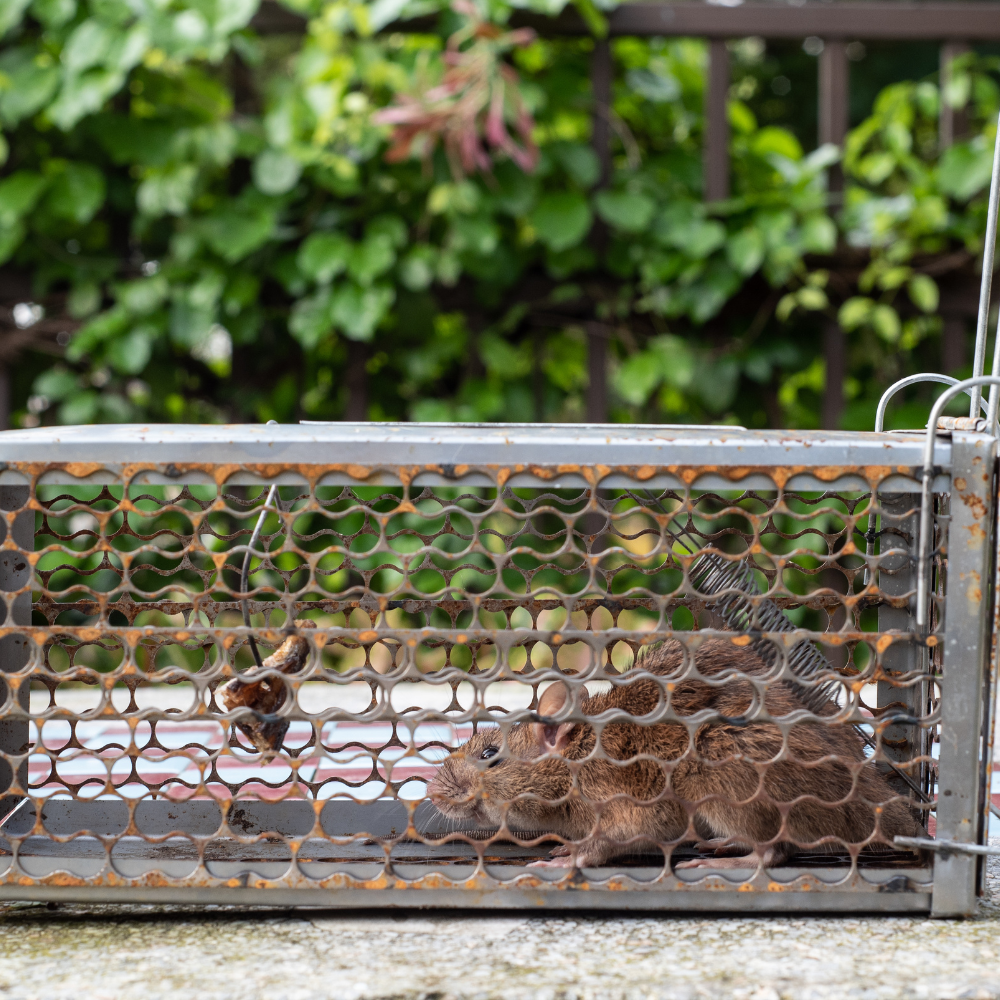
A single mouse can sometimes be managed with well-placed traps. But once you find droppings in multiple locations, or signs of nesting, it’s a sign that a colony is already established. Sealing entry points is essential — without it, traps only temporarily control a population that keeps rebuilding. Sealing with rodent-proof metal mesh is the most durable method for openings around foundations, soffits and pipe penetrations.
If It’s a Rat
Don’t wait. Rats reproduce quickly, cause serious structural damage and present greater health risks than mice. DIY methods are rarely sufficient: their natural wariness toward new objects makes trapping without expertise largely ineffective. Professional intervention makes it possible to locate non-obvious burrows or entry points, assess the true extent of the infestation, and implement a targeted treatment plan.
Both the Norway rat and the black rat are listed as established in Quebec in the provincial government’s official invasive species registry.
Conclusion
Vole, mouse or rat: three very different rodents that require three very different approaches. The comparison table in this article gives you the visual and behavioural markers to quickly identify which species you’re dealing with. Keep the three key indicators in mind — tail length, ear size, dropping size — and cross-reference them with the context: indoors or outdoors, urban or rural, ground level or elevated.
If you have any doubt about the species or the scale of the situation, a consultation with a pest control professional will help you avoid poorly targeted treatments and costly repeat infestations.
FAQ
What Is the Most Visible Difference Between a Vole and a Mouse?
The tail is the most reliable indicator. On a vole, it measures roughly one third of its body — short and barely noticeable. On a mouse, it is long and thin, nearly as long as the entire body. The ears confirm the identification: small and discreet on a vole, large and prominent on a mouse.
Can a Vole Get Into My Home?
Very rarely. Voles are outdoor animals that live in gardens, fields and lawns. They enter buildings only in exceptional cases. If you spot a rodent indoors, it is almost always a mouse or a rat.
Are Field Mice and Voles the Same Thing?
In everyday Quebec usage, the two terms are often used interchangeably — but technically, field mice and voles are two distinct species with different behaviours. If you’re looking to tell them apart in order to choose the right treatment, see our dedicated article.
How Can I Tell If I Have Rats or Mice in My Home?
Dropping size is the most reliable indicator: 3 to 6 mm for mice, 12 to 20 mm for rats. Rats also leave grease marks along walls and baseboards, which mice do not. Heavy, repeated noises in the walls at night are also more suggestive of rats.
When Do Mice Enter Homes Most Often?
Mouse intrusions increase significantly in autumn, from the first cold nights of September and October onward. This is especially true for deer mice in suburban and rural areas. The house mouse, on the other hand, is active year-round in heated environments.
Should I Call an Exterminator As Soon As I See a Rodent?
Not necessarily at the first sign. But once you find droppings in multiple locations, damage to wiring or structure, or repeated activity over several days, professional intervention is recommended. For rats, don’t wait: managing them without expertise is rarely effective.