

Raccoon Removal
Noises in the attic, torn shingles, tipped bins: we get it out, close the way in and clean up.
Do you have a raccoon? The telltale signs
- Heavy noises in the attic or chimney, mostly at night, sometimes the cries of young in spring
- Torn shingles, soffits or vent covers
- Tipped garbage and compost bins
- Patches of lawn rolled back in early summer, when the young dig for grubs
- A pile of droppings always in the same spot: raccoons use "latrines"
Births happen in spring, often in a building. A female that settles in an attic in April raises her young there until summer.
Getting to know the raccoon
Raccoons live year-round in southern Québec, in cities as in the country. How they live explains why they are not handled like an insect.
Description
Reproduction
Habits
Ways in
Health risks
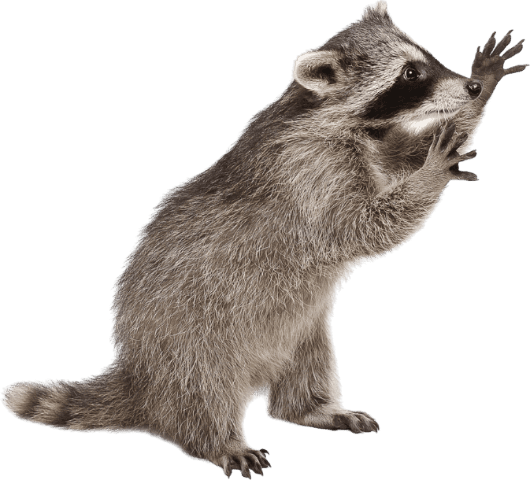
It measures 60 to 96 cm including the tail and weighs 5 to 18 kg. It has a black mask edged in white and a tail with 4 to 6 black rings. Its nimble front paws open lids and lift shingles (Government of Québec fact sheet).
Mating takes place in January and February. After about 63 days of gestation, the female gives birth to 3 to 7 young, mostly in April and May, often in a hollow tree or a building. The young stay with her until the following spring.
It is mostly active at night. It does not hibernate: in deep cold it stays inactive in its den for days, then comes out during thaws. In town it shelters in attics, chimneys, garages and under decks, and feeds from garbage and compost bins.
A raccoon doesn’t squeeze in: it forces its way. It tears off a loose soffit, a vent cover or shingles near a dormer, or climbs down an uncapped chimney. Branches touching the roof work as a ladder.
It can carry rabies, found in raccoons in Montérégie, Estrie and Centre-du-Québec since 2024. Its droppings can contain the eggs of a roundworm (Baylisascaris procyonis) that is dangerous to people. Never handle the animal; after a bite or scratch, wash the wound for 10 to 15 minutes and call Info-Santé 811.
How we deal with a raccoon
Exclusion first. We find the way in and fit a one-way device: the raccoon leaves at night and can’t get back in. In spring we first check for young, so none are shut inside.
No "drop it in the woods". In Québec it is illegal to move a raccoon more than 75 km, and moving live animals is banned in the municipalities covered by the rabies control zone. The government advises against it everywhere: the animal spreads disease and often comes back (Government of Québec).
Repairing the way in. Once the animal is out, we close the opening with sturdy mesh (5 cm or smaller for a raccoon), a chimney cap and solid fastening. Droppings and soiled insulation are removed with protective equipment.
What you can do right now
- Keep garbage and compost in bins with locking lids, and put them out on collection morning
- Don’t leave pet food outside
- Trim branches to at least 3 m from the roof
- Put a mesh cap on the chimney
- Don’t try to catch it yourself: a cornered animal bites, and moving it is regulated by law
Our guarantee. Our treatments are guaranteed over a period agreed in advance: if the problem comes back, so do we, with no hidden fees. See also our article on how to tell you have a raccoon.
Raccoons: frequently asked questions
How can I tell it’s a raccoon in the attic?
The noises are heavy and slow, mostly at night, and there is often a torn opening outside: soffit, vent, shingles. A squirrel makes lighter, quicker noises, mostly by day.
Do repellents work?
Can I trap it and release it somewhere else?
Are raccoon droppings dangerous?
How much does raccoon removal cost?
A raccoon in your home?
Call 514-638-8705 (toll-free: 1-855-472-3352), 24 hours a day, or fill in the form: the estimate is free.