
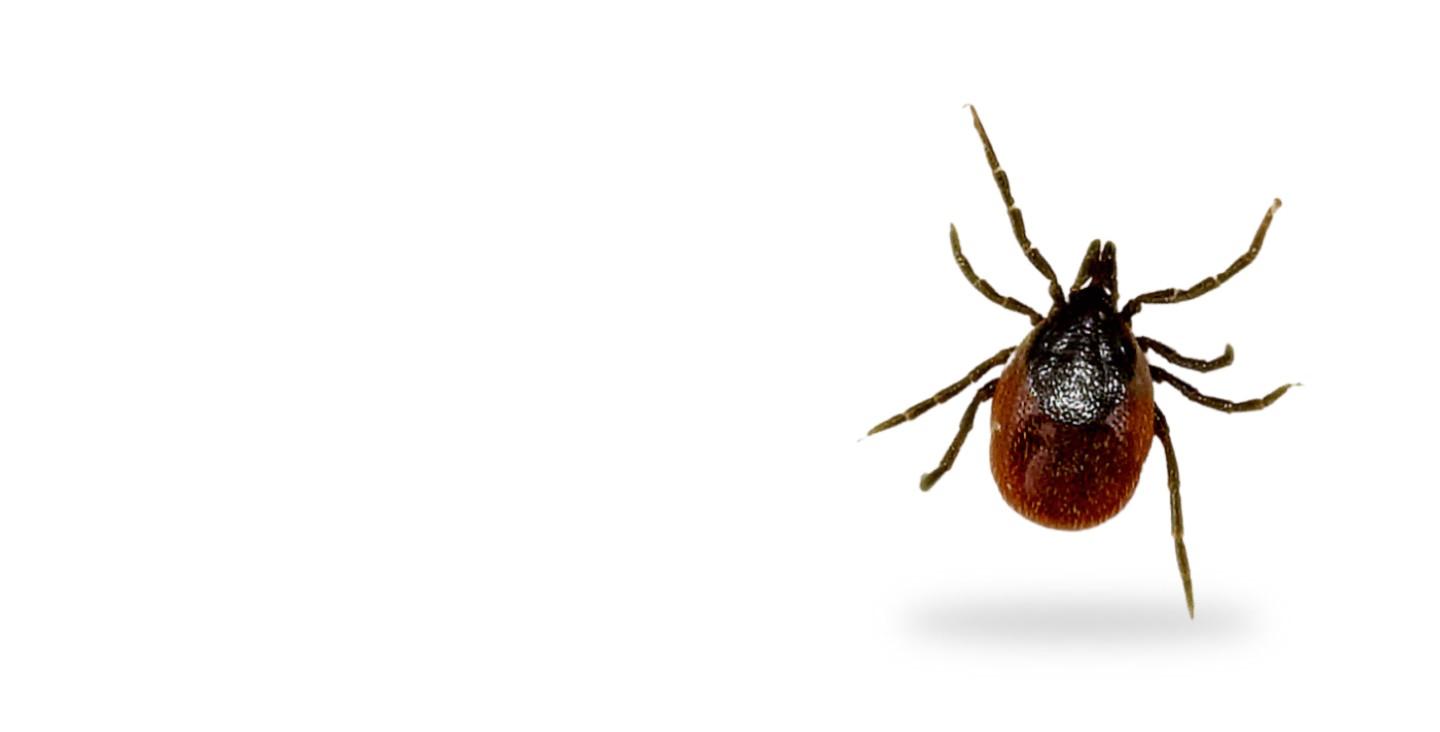
Tick Control
A tick on you, your children or your dog? We make your yard less welcoming to them.
Does your yard attract ticks?
- It borders woods, a dense hedge or tall grass
- Dead leaves and brush stay along the lawn edge
- Deer, mice or chipmunks often cross the yard
- You or your dog find ticks after time in the yard
- Play sets and chairs sit near the edge of the woods
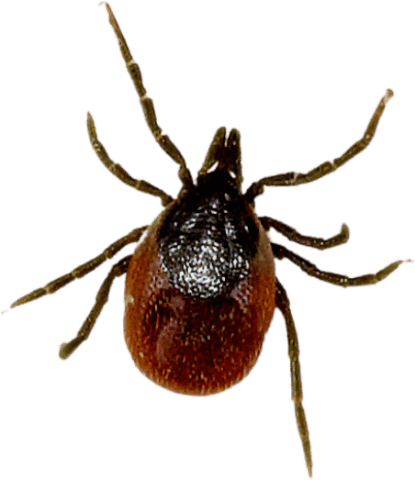
The blacklegged tick measures 1 to 3 mm before feeding: it is often noticed once attached.
Getting to know the blacklegged tick
This is the tick that carries Lyme disease. It is established in southern Québec, and all of Montérégie and the Montréal region are in the endemic zone according to INSPQ.
Description
Life cycle
Seasons
Habitat
Health risks
Before feeding, the adult female measures about 3 mm and the nymph about 1.5 mm; engorged, the female reaches 1 cm. The female has a reddish-orange body and a black shield; the legs are black (Health Canada).
Egg, larva, nymph, adult: the cycle generally lasts two years, with a new host at each stage. Larvae feed on mice and birds; nymphs and adults on people, dogs and deer.
Nymphs are mostly active in spring and summer, adults in the fall. Ticks are active from 4 °C, and whenever it is above freezing with no snow on the ground.
Woods, tall grass, gardens, leaf piles and yard edges. They wait on low vegetation for a host to pass.
Lyme disease: in 2024, 728 cases were acquired in Québec, mostly in Estrie and Montérégie, according to INSPQ. The risk of transmission is very low if the tick is removed within 24 hours of attaching: check yourself after every outing.
How we reduce ticks in a yard
Inspecting the yard. We find the areas where ticks wait: the edge of the woods, leaves, hedges, underbrush.
Landscaping. It is the most effective measure, according to the Public Health Agency of Canada: mowing, clearing edges, and a strip at least 1 m wide of wood chips, mulch or gravel between lawn and woods.
A targeted outdoor treatment. On a highly exposed yard, treating the areas where ticks rest, following the product label, complements the landscaping. See our exterior treatment.
What you can do right now
- Mow often and clear leaves and brush along the edges
- Put play sets and decks in the sun, away from the edge of the woods
- After an outing, check yourself, your children and your pets
- Dry clothes on high heat for at least 10 minutes
- Ask your vet about protection for your dog
Our guarantee. Our treatments are guaranteed over a period agreed in advance: if the problem comes back, so do we, with no hidden fees. Learn more: are you ready for tick season? and a "tick nest": what it really is.
Ticks: frequently asked questions
How do I remove a tick?
With fine-tipped tweezers, grab it as close to the skin as possible and pull gently, without twisting or crushing. Then wash the skin. Note the date; if symptoms appear, call Info-Santé 811.
Do ticks live in the house?
When are ticks active?
How much does a tick treatment cost?
Ticks in your yard?
Call 514-638-8705 (toll-free: 1-855-472-3352), 24 hours a day, or fill in the form: the estimate is free.