
You open the utensil drawer or the cupboard under the sink and find small black grains. Very often those are mouse droppings, and they are the most reliable sign of mice: you rarely see the mouse, but you almost always see what it leaves behind. Here is how to be sure, how to clean them up without risking your health, and what they tell you about the size of the problem.
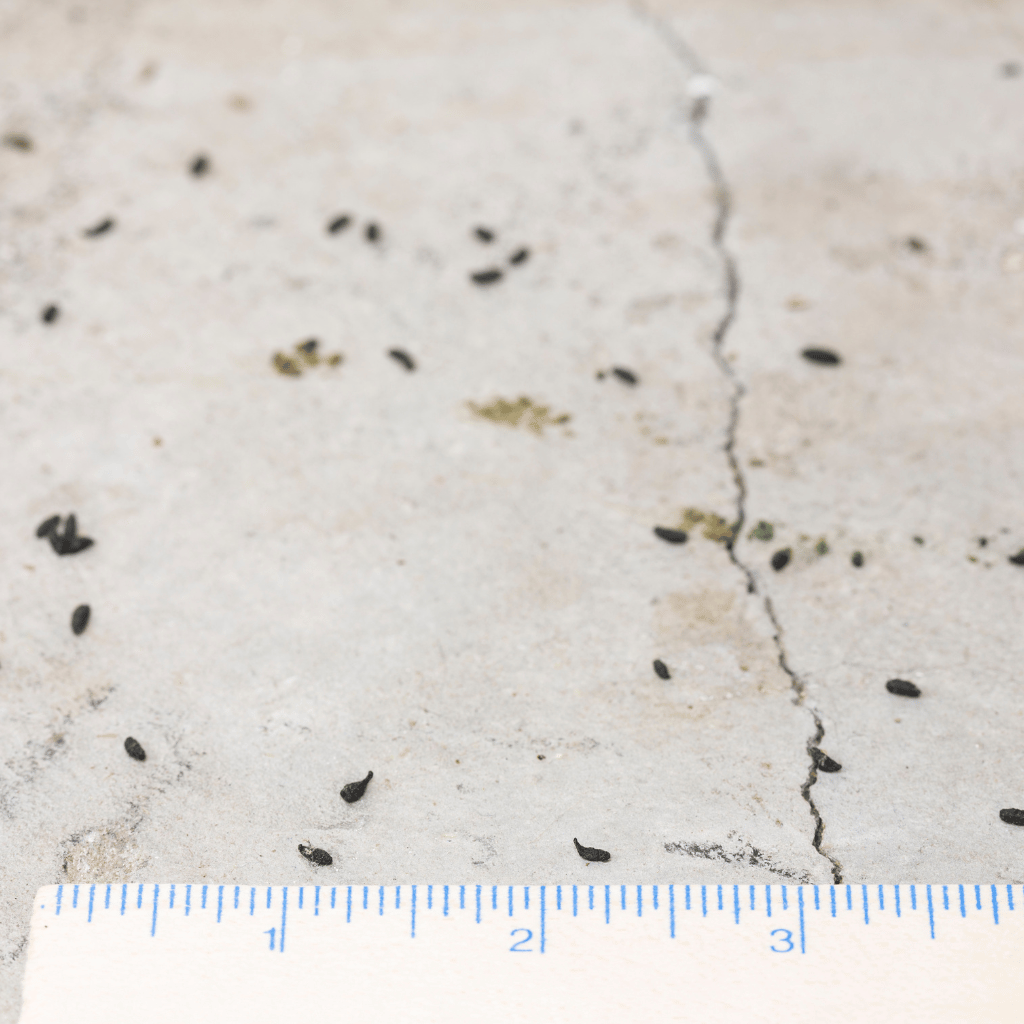
What mouse droppings look like
- Size: 3 to 6 mm, like a grain of rice.
- Shape: elongated, with at least one pointed end.
- Colour: black and shiny when fresh; grey, dry and crumbly after a few days.
- Pattern: scattered along walls, in corners, behind appliances, wherever the mouse travels.
A single mouse leaves dozens a day wherever it goes. Lots of droppings don’t necessarily mean lots of mice, but they do mean at least one has settled in.
Mouse, rat, cockroach or something else?
| What you find | Probably |
|---|---|
| 3 to 6 mm, pointed ends, scattered | Mouse |
| 12 to 20 mm, capsule-shaped, often grouped | Rat |
| Under 2 mm, like ground pepper, or brown smears | Cockroach (German cockroach) |
| Large, crumbly, shiny with insect bits, in piles in the attic | Bat |
To go further with identification, see our comparison voles, mice or rats and our cockroach profile.
Other signs to look for
Health Canada also lists:
- noises at night in the walls or ceiling (scratching, scurrying);
- chewed packaging: cereal boxes, rice bags, pet food;
- gnaw marks on wood, wires, insulation;
- urine and tracks on dusty surfaces;
- an ammonia smell in closed cupboards.
Cleaning up safely: don’t sweep
This is the most common mistake. Sweeping or vacuuming dry droppings raises dust that can make you sick. In Canada, the deer mouse can carry hantavirus, rare in Quebec but serious. The Public Health Agency of Canada recommends the same method for all rodent droppings:
- Air out the room or cupboard for at least 30 minutes before you start.
- Wear rubber or plastic gloves; in an enclosed space (crawl space, cottage, shed), add a filtering mask.
- Spray the droppings with a household disinfectant or a mix of one part bleach to nine parts water, and let it sit for 10 minutes.
- Pick up with paper towels (or a damp mop over a large area), then throw everything out in a sealed bag.
- Wash the surface, then the gloves, then your hands.
Throw out any food whose packaging was chewed or soiled.
What the droppings tell you
- A few droppings in one spot: a passing mouse, often in the fall. Well-placed traps and sealing the entry point are usually enough.
- Droppings in several rooms or on several floors: an established population moving through the walls.
- Fresh droppings after cleaning: activity is ongoing. Clean one area thoroughly, then check again two or three days later: it is the best measure of whether what you are doing works.
To choose between traps and bait, read our article poison or trap for mice; to close up entry points, our guide to sealing your home before winter.
When to call
- You keep finding fresh droppings after two weeks of trapping.
- They are in several rooms, in the attic or in a crawl space.
- The droppings are rat-sized.
- It is a business, restaurant or apartment building: our commercial preventive service includes regular monitoring.
A technician finds the entry points, seals them and places traps where they will work. See our mouse profile, or call 514-638-8705. The estimate is free.
Frequently asked questions
How can I tell if droppings are fresh?
Fresh droppings are black, shiny and soft. After a few days they turn grey and dry, and crumble when pressed with a stick.
Are mouse droppings dangerous?
They can contaminate food and, in the case of the deer mouse, spread hantavirus through dust. That is why you dampen them with disinfectant before picking them up, and never sweep or vacuum them.
I found droppings at the cottage after the winter: what should I do?
Air the place out for at least 30 minutes before spending time inside, then follow the cleaning method above, with a mask. Cottages closed for the winter are typical deer mouse territory.